
The narrow gauge railway serving the mines and factories doesn’t run scheduled goods trains. Instead the trains run on demand. If the Big Nugget Mine is out of explosives or firewood a train will deliver the goods from the Explosives Factory and the sawmill. Likewise, ore wagons will depart Gumnut Gully for the stamper the Big Nugget mine. But how do I know, if there is a demand? After all, it is a model railway and I will not receive a phone call from the managers! Well, a solution is using a laptop to create ‘on demand’.
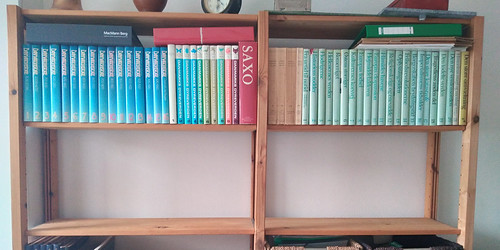
To explain how this will work I need to do a ‘side-step’. Before moving to Australia I have dappled in model railways in Denmark. Before the move, all the rolling stock were put into storage and the lay-out itself given away to a model railway club. With no need for the current layout, the wagons and locomotives sat idle in a cupboard. Idle were also a couple of shelves in the bedroom and an idea emerged. Couldn’t the shelves and some of the wagons be turned into a shunting puzzle?

A track plan from a station (Kappendrup) on the former railway between Odense and Bogense was drawn on ‘Anyrail’ and the necessary points and tracks were bought and placed on the shelves. The next task was to work out a spreadsheet on the laptop.

W: wagon L: Locomotive G:Guards van
The ‘W’ shows the possible position of various wagons. They are all more or less equal in lengths. A total of 12 wagons can be accommodated at the station. The ‘L/G’ indicates the final position of the locomotive and the guards van. One at either end of the departing train.
The spreadsheet look likes this (it is in Danish, but I think you will get the idea):

Column A: Description of the various wagons. ‘-‘ indicates no wagon. ‘Togfører’ = guards van
Column B: Each wagon (including ‘-‘) is allocated a random number between 0 and 1. The locomotive and guards van a number between 1 and 2.
The data is sorted is sorted after column B and I get a random list of wagons. The first three wagons are placed in track no. 3a. The next three (including one ‘-‘) in track no. 3b. Two wagons in track no. 2. Three wagons in track no. 1. The last wagon is in the private siding. Finally the locomotive and the guards van are placed around the wagons in track no. 1 and the train is ready to depart towards Bogense. To make the shuttle a bit difficult, the short tracks and the end of the station are only long enough for a locomotive and one wagon. A puzzle will take between 10 and 15 minutes to solve. With 159,667,200 possible combinations I have enough to solve during the rest of my lifetime.
Back to the narrow gauge railway. I have tried to use the same concept. Let the laptop decide, if the sawmill needs more logs loaded up in Gumnut Gully. Well, that is the easy part. It gets complicated with the ore wagons. In Gumnut Gully they go into the siding along the Long Tunnel Mine. At the Big Nugget Mine they share a siding with ordinary (and longer) wagons. As a consequence the number of ore wagons at the Big Nugget Mine determines the number of other wagons at the same mine.

Column A: The various wagons (‘-‘ indicates no wagon).
Column B: A random number between 0 and 1 (the ore wagons) or between 1 and 2 (the longer wagons).
Column C: Sorting ore wagons between Gumnut Gully, ‘0’ (value of ‘B’ less than 0.5) or Big Nugget Mine ‘1’
Column D: GG = Gumnut Gully BG = Big Nugget Mine
E1: Sum of C1;C4
In this case E1 = 0 (all ore wagons are in Gumnut Gully). The distribution of wagons follows the coloured boxes in column D. Green is Wombat Creek; yellow is Big Nugget Mine; purple is Gumnut Gully (excluding four ore wagons). I still have to refine the spreadsheet. At the moment the actual position of the wagons at the station is not included.

In this example one ore wagon (no. 1) is going to the Big Nugget Mine. E1 equals 1 and the Big Nugget Mine will only have room for three longer wagons (yellow column E).
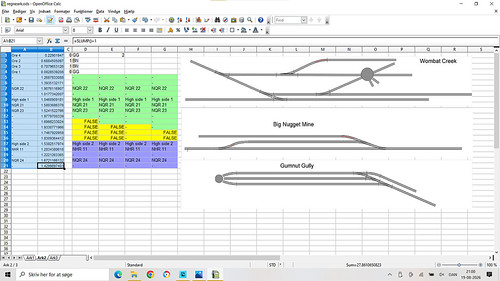
Two ore wagons (no. 2 and 3) are placed in the Big Nugget Mine. Since the ore wagons are quite short the siding has still room for three longer wagons (yellow column F)

With three (or four) ore wagons at the Big Nugget Mine the spreads looks like this. Only two long wagons can be allocated to the Big Nugget Mine (yellow column G).
I hope all of this make a sort of sense. I hope you have got an idea of how to use a spreadsheet for ‘trains on demand’. I am sure the concept will work for larger layouts, too. Could the spreadsheet be organised differently? Probably. If you want further information, have any questions or propose improvements, leave a comment or send me an email.
